

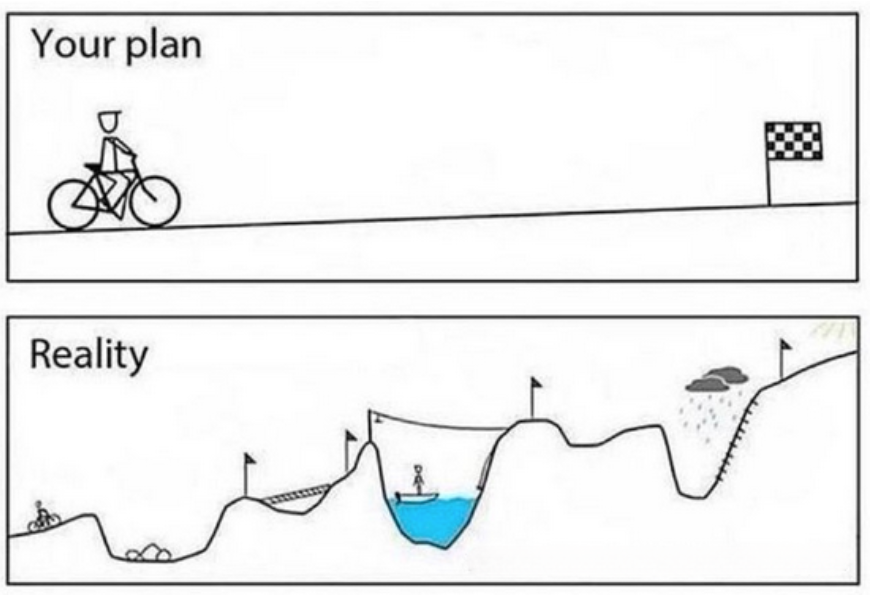
When thinking about strategic plans in schools it might be easy to be inspired as a school leader with your goals, and the path you can ride along armed with your map which tells you the shortest route to get you there. Who would argue with a plan?
It goes without saying in this age of ‘what works’(Biesta, 2010), high stakes testing, huge media interest in schools and schooling, increasing government accountability, pressure on Principals for schools to continually improve student outcomes, that the ‘heroic’ Principal has to have a plan to ‘get there’, to the checkered flag.
However, we all recognise ourselves in the ‘reality’ picture below if we have had any experience in leading schools. So, why do we persist in thinking that if we had a plan – a strategic plan – we can follow it and we will get to our longed-for destination – when we know life is more complex than that? And plans rarely succeed anyway?
if you would like to have a conversation about how to further develop strategy and strategic leadership in your school context. Far from bringing clarity, ‘strategic plan’ is a troubled term and the quest for the brilliant ‘strategic plan’ has caused us to look in the wrong direction for sustainable change in schools. Research confirms that most strategic planning processes in fact fail. Kotter (2007) suggests that education is hardly unique in failing to transform strategy into action, concluding that more than 70 percent of business strategic plans are never implemented. Some even declare that the strategic plan is dead. That may be so, but strategy certainly isn’t.
What is strategy?
Strategy is a way of intentionally thinking and acting by giving sense to a specific school vision or mission (Eacott, 2011). Strategy is mindset rather than a skillset, strategy is curious, strategy asks ‘what if there is another way’? Strategy is creating something new. It is the intersection between the future and the present. Strategy demands that the aims of the school are challenged (Bell,2004).
This is risky for a school leader and calls for strategic leadership within a strategically focused school (Carvahlo et. al, 2021). It is strategic leadership which gets us to the chequered flag.
So, who is the strategic leader?
The strategic leader knows that strategy and planning are different concepts, with the strategy being way more than the pursuit of a plan (Davies, 2006). Planning and acting are related but must emerge from the strategy.
My own research with colleagues as well as other relevant research helps to deepen this picture. Strategic leaders:
- know ‘who owns strategy’. They work with Boards and Board Chairs – thinking strategically together – beyond a focus on risk and compliance – towards strategic action
- are good at setting a vision, knowing and adapting to the context and the circumstances of the school.
- are conscious and intentional and can hold both short term and long term in a creative and healthy tension (Davies 2007)
- can’t do it alone. They consciously develop collaborative school leadership cultures to increase capacity for school improvement (Woods & Roberts, 2018)
- think and act ethically through strategic initiatives and conflict/ dilemmas (Quong, et.al,2010).
- Strategic leaders are both evidence – informed and values based in their leading practices
Strategic leaders are good strategists above all (Eacott,2011).
How much strategic leadership takes up your day-to-day practices? What drags you away from what you know to be important strategic work? If you had a magic wand what is one thing you would change to enable you to focus on what really matters?
Let us know your questions and comments! If you’d like to have a conversation about how the role of governance in your school or how you might start a journey for change, email us at team@consciouseducation.com.au.
References
[Bell, L. (2004). Strategic planning in primary schools. Management in Education, 18(4), 33–36. https://doi.org/10.1177/08920206040180040701
Biesta, G. J. (2010). Why ‘what works’ still won’t work: From evidence-based education to value-based education. Studies in Philosophy and Education, 29, 491-503.
Carvalho, M., Cabral, I., Verdasca, J. L., & Alves, J. M. (2021, October). Strategy and strategic leadership in education: A scoping review. In Frontiers in Education (Vol. 6, p. 706608). Frontiers Media SA. https://doi.org/10.3389/feduc.2021.706608
Davies, B. (2006). Processes not plans are the key to strategic development. Management in Education, 20(2), 11–15. https://doi.org/10.1177/089202060602000204
Eacott, S. (2011). Leadership strategies: Re-conceptualising strategy for educational leadership. School Leadership & Management, 31(1), 35–46. https://doi.org/10.1080/13632434.2010.540559
Kotter, J. P. (2007, January). Leading change: Why transformation efforts fail. Harvard Business Review, 85(1), 96–103.
Quong, T., & Walker, A. (2010). Seven principles of strategic leadership. International Studies in Educational Administration (Commonwealth Council for Educational Administration & Management (CCEAM), 38(1).
Woods, P., & Roberts, A. (2018). Collaborative school leadership: A critical guide. Sage.]